


Planning a Custom Software Project: Requirements, Costs, Timelines, and Choosing a Developer
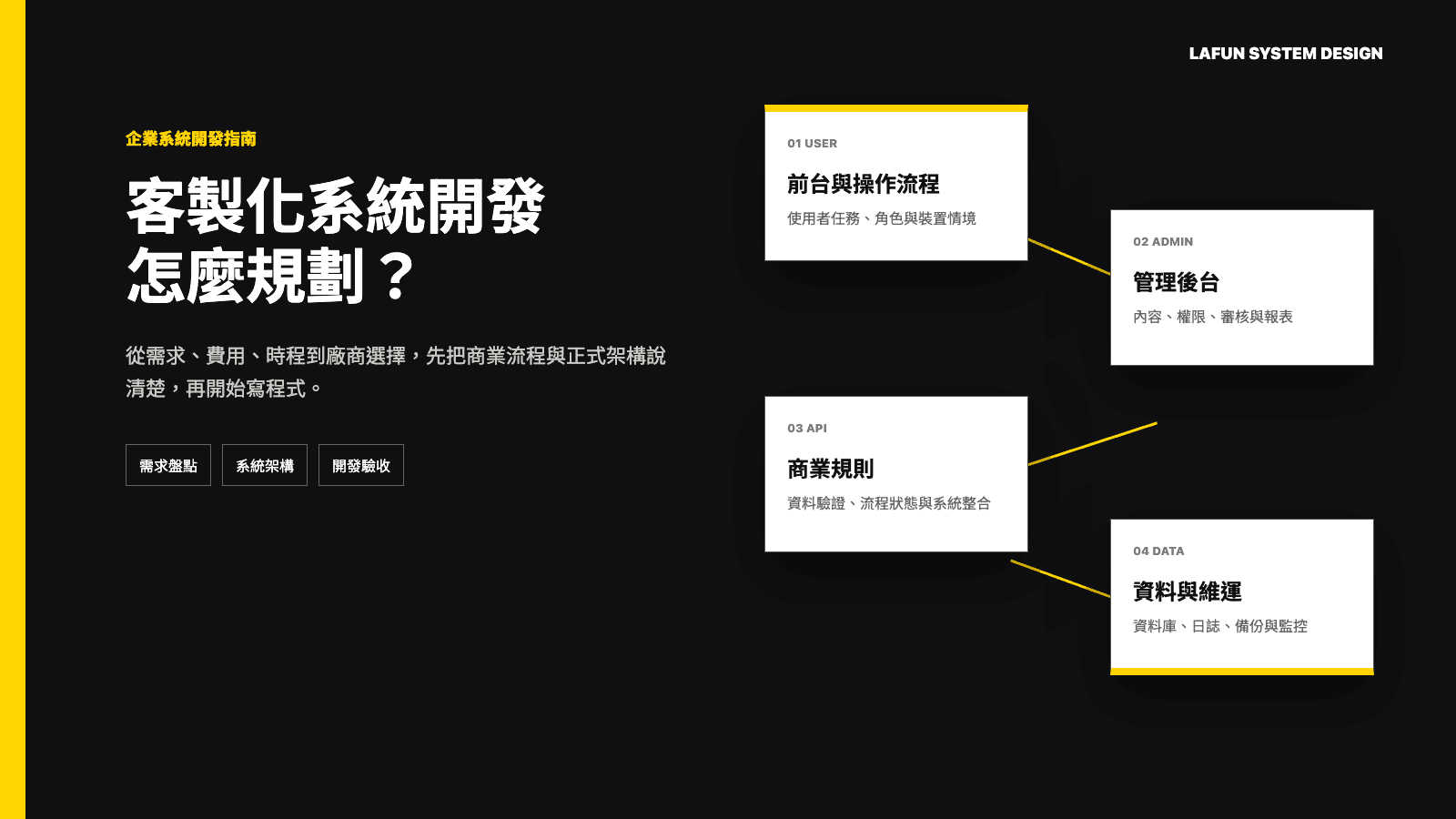
When a company wants to integrate Excel, forms, email, and manual follow-up into a single system, the first question often is “How much does development cost and how long will it take?” However, customized system costs and timelines are not simply calculated by page count, but determined collectively by process complexity, role permissions, data structure, external integrations, exception scenarios, and post-launch maintenance responsibilities. Clearly defining problems and scope is essential to obtain comparable and actionable quotations.
What is customized system development?
A customized system is an application designed according to a company's actual workflows, such as project management, customer relationship, knowledge base, quoting and invoicing, membership services, appointments, content management, or cross-system data integration. This does not mean all features must be developed from scratch; rather, it involves selecting appropriate frameworks, cloud services, and existing components, then creating exclusive features for genuinely distinctive processes.
When is it suitable to develop a customized system?
- Existing SaaS cannot meet key processes, causing teams to repeatedly enter data across multiple tools.
- Different roles require clear data permissions, approval points, and operation records.
- There is a need to connect official websites, CRM, ERP, payment gateways, email, file storage, or other internal APIs.
- Excel or manual forms have led to version confusion, data omissions, and untraceable issues.
- The service itself is the company's competitive advantage and requires building an operation experience that cannot be replaced by generic products.
If workflows are still frequently changing, the user base is small, or standard SaaS can satisfy most needs, using existing tools first may be more efficient. The goal of customized development is not to systematize all work but to solve core processes that standard tools cannot reasonably handle.
Six key pieces of information to prepare before requesting a quote
- Goal: What is the biggest current problem? Do you want to improve timing, reduce error rates, or increase management transparency?
- Users: What roles exist? How many people use the system? Which data can each view and operate?
- Processes: From data creation to closure, what statuses, approval steps, notifications, and exceptions are involved?
- Data: Where is existing data stored? Does it need cleaning, importing, synchronization, or historical version retention?
- Integration: Which third-party services, devices, or existing company systems need to be connected?
- Constraints: Expected launch date, budget range, information security regulations, and internal decision-making processes.
There is no need to produce a complete specification upfront, but at least provide real usage scenarios and current practices. A good development team will help organize these descriptions into processes, data, permissions, and acceptance criteria, rather than merely translating requirement lists into screens.
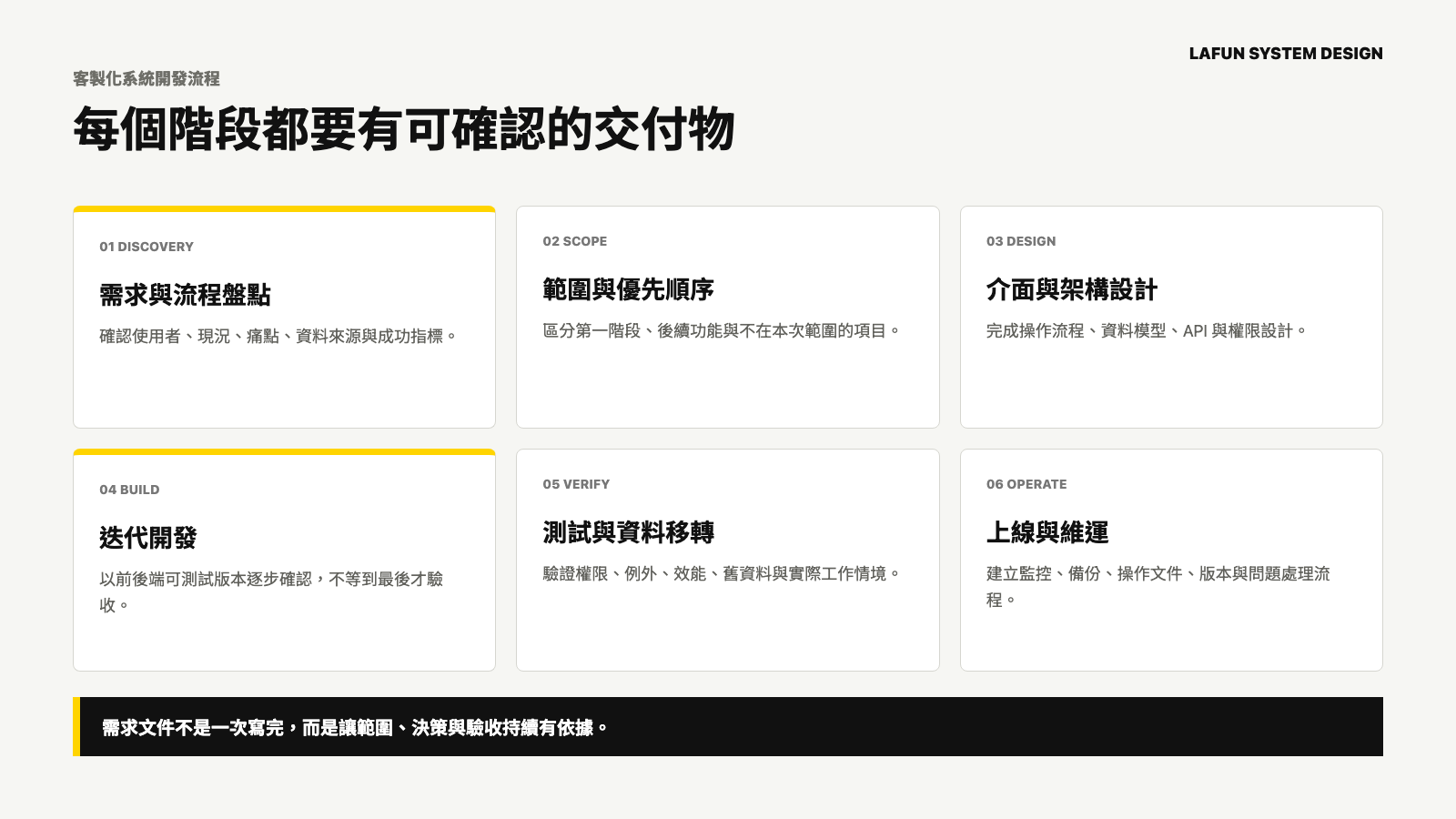
Six stages of customized system development
Stage one: requirements and process assessment
Interview actual users to confirm current workflows, data sources, repetitive tasks, bottlenecks, and error types. The output of this stage should include problem definition, roles, main workflows, data flows, and success indicators. Focusing only on desired screens often leads to discovering unaddressed business rules after development.
Stage two: scoping and prioritization
Divide features into those that must be completed in the first phase, those that can be postponed, and those not addressed this time. The first version should form a workflow that truly accomplishes the work, rather than each module having bits done but unusable. The scope document should also record assumptions, limitations, and change procedures to avoid differing interpretations of what is "included."
Phase 3: Interface, Data, and Architecture Design
Interface design must validate how users complete tasks; the data model defines how customers, projects, documents, statuses, and relationships are stored; the system architecture needs to clarify responsibilities among the frontend, backend, APIs, database, files, and third-party services. These decisions directly affect future scalability and maintenance costs.
Phase 4: Iterative Development and Regular Reviews
Development should not be left until the last day for demonstrations. It is recommended to break down the process into testable versions and regularly verify operations, data, and rules. Each adjustment must be classified as a scope revision, requirement clarification, or new feature, with records of impacts on schedule and cost.
Phase 5: Testing, Acceptance, and Data Migration
In addition to normal workflows, test cases of insufficient permissions, missing data, duplicate operations, third-party service failures, and high traffic should be included. For data migration, field mapping, cleaning, and trial imports should be done first, confirming record counts, relationships, and sampling results. Acceptance should be based on pre-agreed criteria, not just whether screens display.
Phase 6: Launch, Monitoring, and Maintenance
Official launch requires domains, certificates, environment variables, backups, error monitoring, operation logs, and recovery plans. It is also necessary to establish who is responsible for accounts, data correction, content maintenance, issue reporting, and version updates. Launching the system does not mark the project’s end but the beginning of actual operation.
What factors determine the cost of custom system development?
Systems with the same name can vary greatly in workload. For example, a "project management system" might be a basic case list or include quotations, contracts, scheduling, billing, invoices, permissions, notifications, and reports. Reliable estimation must first break down the following items.
- Roles and permissions: the number of roles, field-level permissions, departmental isolation, and proxy operations.
- Processes and statuses: approval levels, returns, cancellations, supplementary documentation, reminders, and automated rules.
- Data and reports: fields, relationships, historical versions, exports, dashboards, and search functions.
- External integration: quality of third-party APIs, authentication methods, rate limits, and failure compensation.
- Interface and devices: backend density, mobile operation, accessibility, multilingual support, and brand design.
- Data migration: old data formats, cleaning difficulty, attachments, and verification methods.
- Quality requirements: performance, cybersecurity, test coverage, redundancy, auditing, and regulatory compliance.
- Maintenance scope: hosting, monitoring, backups, customer service, warranty, and future version updates.
What should be examined in a quotation besides the total price?
- Whether the quotation clearly lists included and excluded features, platforms, and deliverables.
- Whether responsibility is assigned for requirement analysis, UI/UX, frontend, backend, testing, deployment, and maintenance.
- Whether fees for third-party services, cloud usage, SMS, email, or model APIs are charged separately.
- How change requests are priced, who can approve changes, and how they affect the schedule.
- How ownership of code, design files, data, domains, and third-party accounts is arranged.
- Whether warranty covers only defects in the original specifications or also includes new requirements and operational assistance.
The lowest total price does not necessarily mean the lowest total cost. If the scope is unclear or there is no responsibility for testing and deployment, later rework or rewrites may incur higher costs. When comparing quotes, first confirm whether all parties are estimating the same scope.
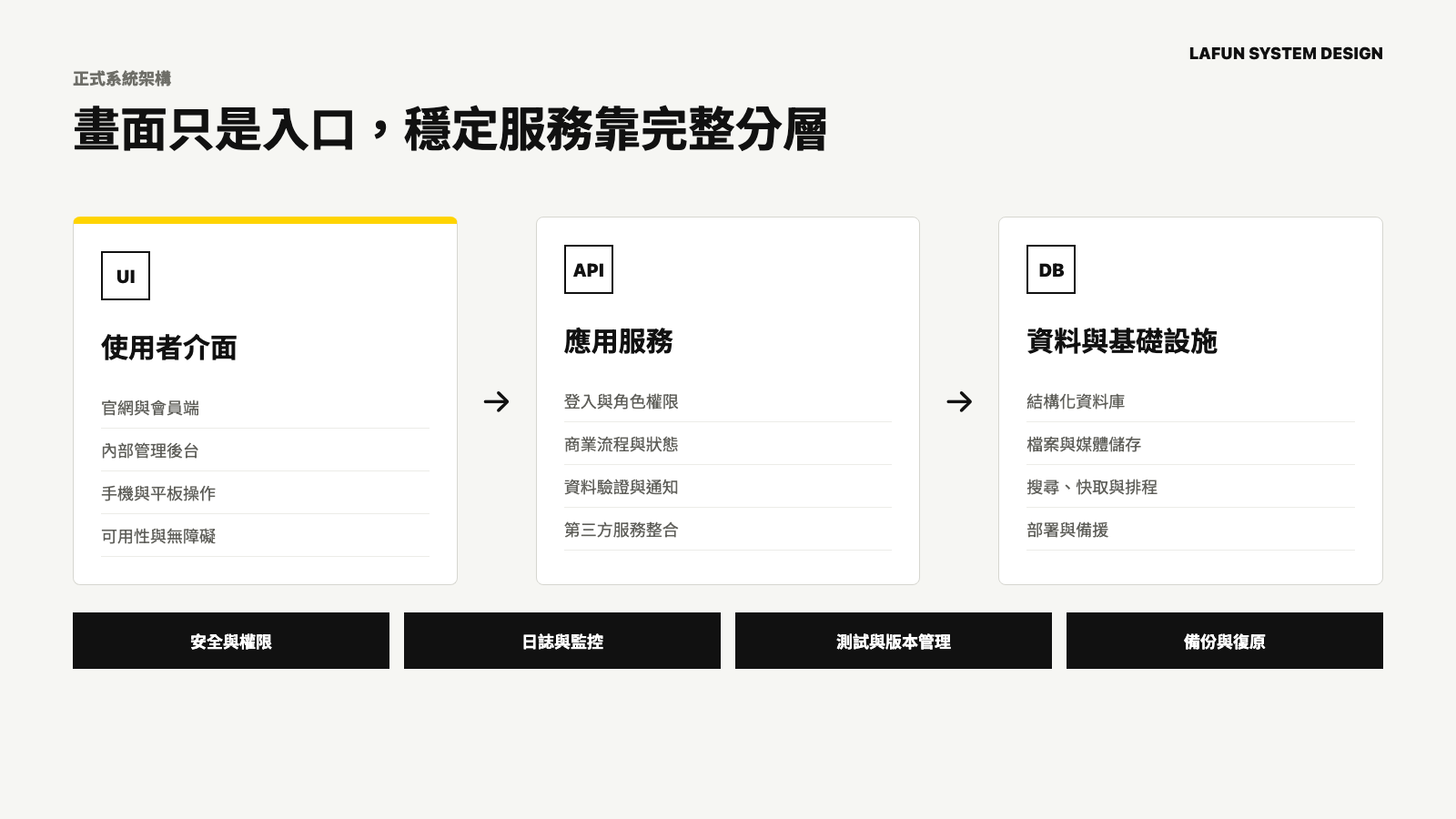
Formal systems include more than just the front-end interface
Users see the website or backend, but what truly determines system stability also includes login and permissions, business rules, APIs, databases, file storage, notifications, scheduling, logs, monitoring, and backups. If a prototype only stores data in the browser or writes all logic on one page, maintenance becomes difficult as features grow.
- Front-end: responsible for user experience, form states, error prompts, and multi-device rendering.
- Backend API: uniformly enforces permissions, authentication, process states, and business rules.
- Database: uses clear fields and relationships to store core data, avoiding stuffing all content into a single JSON.
- File storage: manages images, videos, documents, access permissions, and lifecycle.
- Maintenance capabilities: include deployment, monitoring, backups, audit logs, and disaster recovery.
How long does system development take?
Schedules should be estimated based on verifiable scope rather than fixing a date first and cramming all features in. Factors influencing schedule include decision speed, requirement changes, third-party APIs, data quality, testing feedback, and launch reviews. A more stable method is to complete requirements inventory and prioritization first, then schedule design, development, testing, data migration, and launch buffer.
Common causes of schedule delays
- Key users appear too late; workflows discovered post-development differ from actual operations.
- No single decision-maker; conflicting rules provided by different departments.
- Third-party API documentation incomplete or production accounts and test environments obtained too late.
- Old data formats are disorderly; data migration only addressed at the end.
- New features added at every confirmation without adjusting scope, costs, or dates accordingly.
How to choose a custom system development vendor?
- Do they first seek to understand business processes rather than promising all features outright?
- Can they explain the architecture of front-end, back-end, database, deployment, and third-party integrations?
- Do they provide phased delivery, test environments, progress tracking, and change request records?
- Do they include permissions, exception handling, data validation, and logging within the formal scope?
- Can they clarify data and code delivery, account ownership, and offboarding methods?
- Is there a plan for launch, monitoring, backups, warranty, and ongoing maintenance?
- Are past cases comparable in complexity to your issues, not just visually similar?
What should contracts and acceptance criteria at least clearly specify?
- Project scope, milestones, deliverables, payment terms, and points of contact for both parties.
- Main workflows per role, supported devices, browsers, and external integrations.
- Acceptance environments, test data, defect severity levels, and correction deadlines.
- Procedures for handling requirement changes, pauses, delays, and third-party factors.
- Ownership of code, data, design, domains, cloud, and third-party accounts.
- Launch support, fixed definition assurance, maintenance services, and data delivery after service termination.
Common failure modes
- Considering the number of features as complete requirements without describing roles, processes, and exceptions.
- Demanding a fixed total price upfront, then continuously adding unestimated new requirements.
- Only creating UI prototypes, neglecting APIs, databases, permissions, and formal deployment.
- Transferring all old processes unchanged into the system, missing opportunities to simplify work.
- No internal responsible person assigned; all decisions and data await guesses from external teams.
- No plan for maintenance, backups, and account handover until problems occur.
Common questions
The requirements are not complete yet. Can I request a price first?
Yes, but initially it is better to obtain a scope-level estimate or conduct a requirements analysis phase first. If a fixed total price is demanded directly, vendors can only increase risk reserves or list unclear items as additional later.
Can I start with an MVP?
Yes. An MVP should preserve one complete, practically usable core process, and establish permissions and data foundations with a proper architecture. MVP means reducing scope, not omitting security, data, and maintenance responsibilities.
Can AI features be added in the future?
Yes, but data structures, permissions, and API boundaries must be clear first. AI can assist with search, summarization, classification, drafting, and image processing, but application of output, data scope, and manual verification should still be controlled by system processes.
Start with the most important process
When preparing a custom system, first select the process that occurs most frequently, most affects operations, and is easiest to measure improvement results. Organize users, data, statuses, exceptions, and expected outcomes, then confirm the phase one scope with the development team. If you are planning enterprise backends, project management, knowledge systems, membership services, or cross-system integrations, you cancontact us to discuss requirements and implementation methods.